Anxiety Relief
2 strategies to help your child get work done if they are struggling with anxiety

Not much of a preface in this article other than: for those that have dealt with anxiety, are dealing with it, or are struggling to help their child or other loved ones who have anxiety know… it really sucks. It's not fun, it can be quite debilitating and it's often hard to help them and ourselves. That said, I believe strategies need to be simple, easy to implement, and easy to try. That was the goal of this article. A bunch of stuff you could try right after reading this that could possibly help alleviate some anxiety so that you can help your child or whoever it is, get some work done and be a little more productive.
BIG DISCLAIMER:
The strategies or techniques below are not going to cure someone's anxiety. If someone is struggling with anxiety, there are going to be bigger, deeper-rooted reasons why that will need to be and should be addressed.
These are smaller strategies that have been helpful with many students that are also easy to implement on your end, as the parent, professional, or whoever is reading this, and easy for the child to try.
With that out of the way, here are 2 strategies that can help with anxiety in students:
1. Brain / Mind Dump
Tell your child that for 2 minutes, they are going to write down everything that is on their mind: everything they have to do, anything that's bothering them, etc.
Tell them they can write however they want: bullet points, sentences, a paragraph - it doesn't matter. It doesn't matter what it looks like because it is just a way to help them clear up the space in their head.
Bonus points if you do this with them. A partner is always comforting, especially when navigating difficult feelings like anxiety.
After they have written some things down, you'll help them address everything that they wrote.
You will look at all of things and rank them: whatever is most important or urgent is what needs to be addressed and worked on right now and everything that is not as important can wait until later. You are essentially making a tier list or hierarchy of importance.
See the example below.
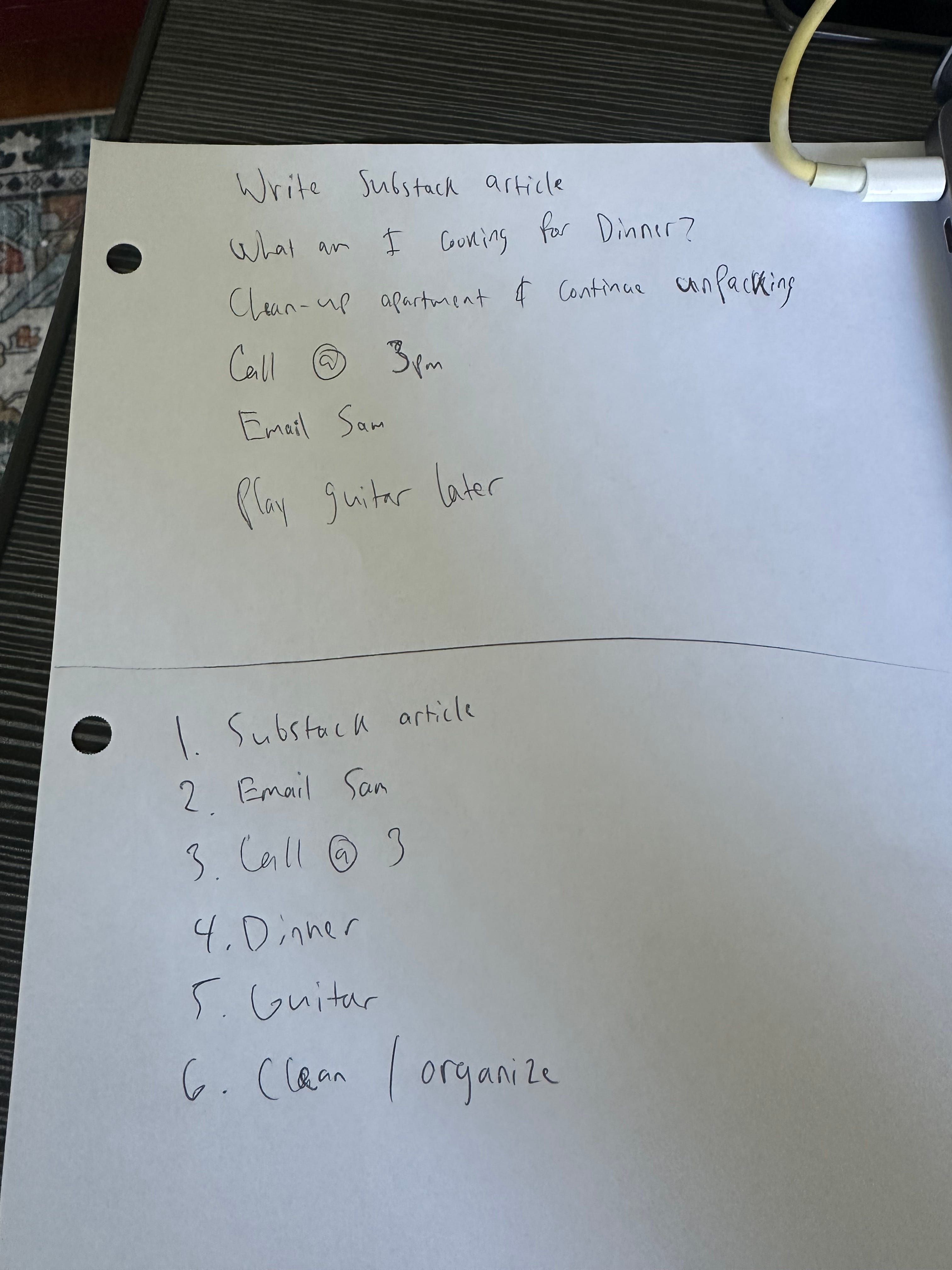
I did this on behalf of myself. As you can see in the first half of the page, it's all of the things running through my mind. Some work-related tasks, some personal things like cleaning up/organizing my apartment, some personal stuff like playing guitar, and some random thoughts like what I want to eat for dinner. This activity is discrimination-free; just get all of the ideas out of your head and onto the paper.
The purpose or goal of this exercise is to help your child free up the space in their head by getting everything on the paper, so they don't have to try and remember it all (because when they try to remember it all, it leads to them forgetting).
This can really help to reduce being overwhelmed by everything that is going on and everything that needs to get done. A lot of the time when they see everything on paper, in front of them, it helps them realize they have been stressing for no reason. Those tasks and all the to-dos actually aren't as intimidating as initially thought.
It also helps them organize and plan because they see everything they have to do and can figure out how to get it all done. Seeing everything right in front of their face is so helpful for planning because it's tangible now. It's not just ideas floating around in their head—it's on paper, which makes it more real, which means they can actually go and get it done.
Lastly, and this is essentially a reiteration of what was already stated above, it can be freeing since all their thoughts and priorities are out of their head and on paper. Finally… all of the things that have been stressing them out are now visible. It's essentially Kidlin's Law, which states that when you write a problem down, it's already been halfway solved. It's not that simple but definitely better than keeping everything tucked away in our heads!
2. Dealing with perfectionism (as it pertains to writing/school work)
Anxiety often leads to perfectionism, and when it comes to getting work done, specifically homework, there are some things you can do with your child to help them out.
If writing is a place where their perfectionism manifests, have them put an asterisk on whatever word, sentence, paragraph, that is stressing them out. Tell them that they'll come back to this. The more time they waste fixating on a word, etc., the less time they will have to finish the whole thing. Tell them that completing the whole is always better than getting part of it "perfect." Tell them that they can't edit anything if they have nothing on the page. Similar to the brain dump, just get it all out and then you can go back and edit afterwards. Progress over perfection.
You can also try helping them set a time limit for their assignments. Tell them that they'll come back to edit after the timer goes off and during this phase of the writing, they just need to get something on the page. Keep in mind that this will be uncomfortable for them so give them lots of positive affirmations all throughout the process and really try to encourage them.
Another way to frame the write-first, edit-later, is if they are struggling to get started, have them just write one word or one sentence. Instruct them not to think about what comes next; only the task in front of you, which is getting just a word or sentence down. Then you do another and another, etc. Next thing you know… a lot of writing has been done!
Like I'm always going to mention, this is by no means a comprehensive list or cure-all. Just some strategies you can try to help mitigate and alleviate some of the struggle. Experiment and see what sticks, and then double down on that.
The best techniques are always going to be the ones that help your child and that they actually use. Whatever works and sticks is what should be used, and those are technically the "best!"
Keeping the strategies narrow and concrete makes them usable in the moment anxiety shows up, not just after the fact. Externalizing thoughts onto paper and loosening the grip of perfectionism both reduce cognitive load enough for action to start. That shift from managing feelings to restoring access to the task is often what allows progress to happen at all.