3 simple study techniques to teach your child
Start this back to school season by helping your child learn to study more effectively!

In honor of the back-to-school season, it's the perfect time for this week's article. Below you'll find 3 study skills strategies—3 things you can do to help your child study more efficiently.
We picked these 3 on purpose because they are super easy to implement and realistically do. They don't require too much time (one of them doesn't require any of your time or effort at all) and can be done very casually and honestly, pretty much from anywhere (yes, in the car, going to the supermarket is okay).
That said, there’s one quick preface before we go into the 3 strategies. Students are generally not taught how to study in school. It seems counterintuitive that school wouldn't teach students how to study the material they are teaching them, but that tends to be the reality of how it is. And it is understandable that most teachers simply don’t have the time to. However, teachers will often tell students "make sure to study," but students have rarely ever been provided with insight or taught how to actually do it most effectively. Index cards and reading notes is not the only way to do it. And just because a student is getting good grades, it doesn’t always mean that they are implementing efficient study methods.
So, to help them start their year off well, here are 3 study skills you can (easily) teach to your child!
1. Summary Method
This technique pertains mostly to work that is based on reading or videos, but with some alteration, it could be totally adapted to other types of work. Here is the strategy:
When your child has a reading assignment or has to watch a video, have them read a few paragraphs of the book, text book, or watch a few minutes of the video.
Then once they are done, have them write a summary of what they read or just watched.
Then, have them verbally retell that summary that they just wrote, WITHOUT looking at it.
Have them do this periodically throughout their whole reading/video assignment.
By the end, have them make a list of everything they could remember and what they couldn't.
Have them study the material they couldn't remember more than what they could remember.
An important thing to instruct them on: as they are reading or watching, they should not be highlighting information or taking notes. They just need to focus as much as they can on what's in front of them. Oftentimes, when students highlight or try to take notes, they are looking for important information, which gets in the way of them actually processing and internalizing what they just read/watched. So it becomes more about looking or parsing for information than actually trying to understand and process what's right in front of them. Tell them that they can always go back later to highlight, but for now, they should just focus on reading and watching— nothing else.
If you want to make this most effective, you should read what they are reading and watch what they are watching so that when they write their summary and verbally retell it, you can see if they got all of the necessary information. Understandably, this won't always be possible, so when they retell their summaries to you, ask clarifying questions to really see how much they understood vs. how much they didn't. While they are summarizing it to you, it will be pretty obvious what they know and what they don't, especially when you start asking some questions.
Ideally, by the end, they'll have a list of information they had trouble both writing and speaking, which will be the focus of what they study. The things they could recall, both written and verbalized, were internalized and processed more so, they don't need as much attention.
2. Feynman Technique
There is a quote by Albert Einstein: "If you can't explain it simply, you don't understand it well enough." Juxtaposed with that, is a method of learning/teaching developed by physicist Richard Feynman called the Feynman Technique. It's summarized in the diagram below:
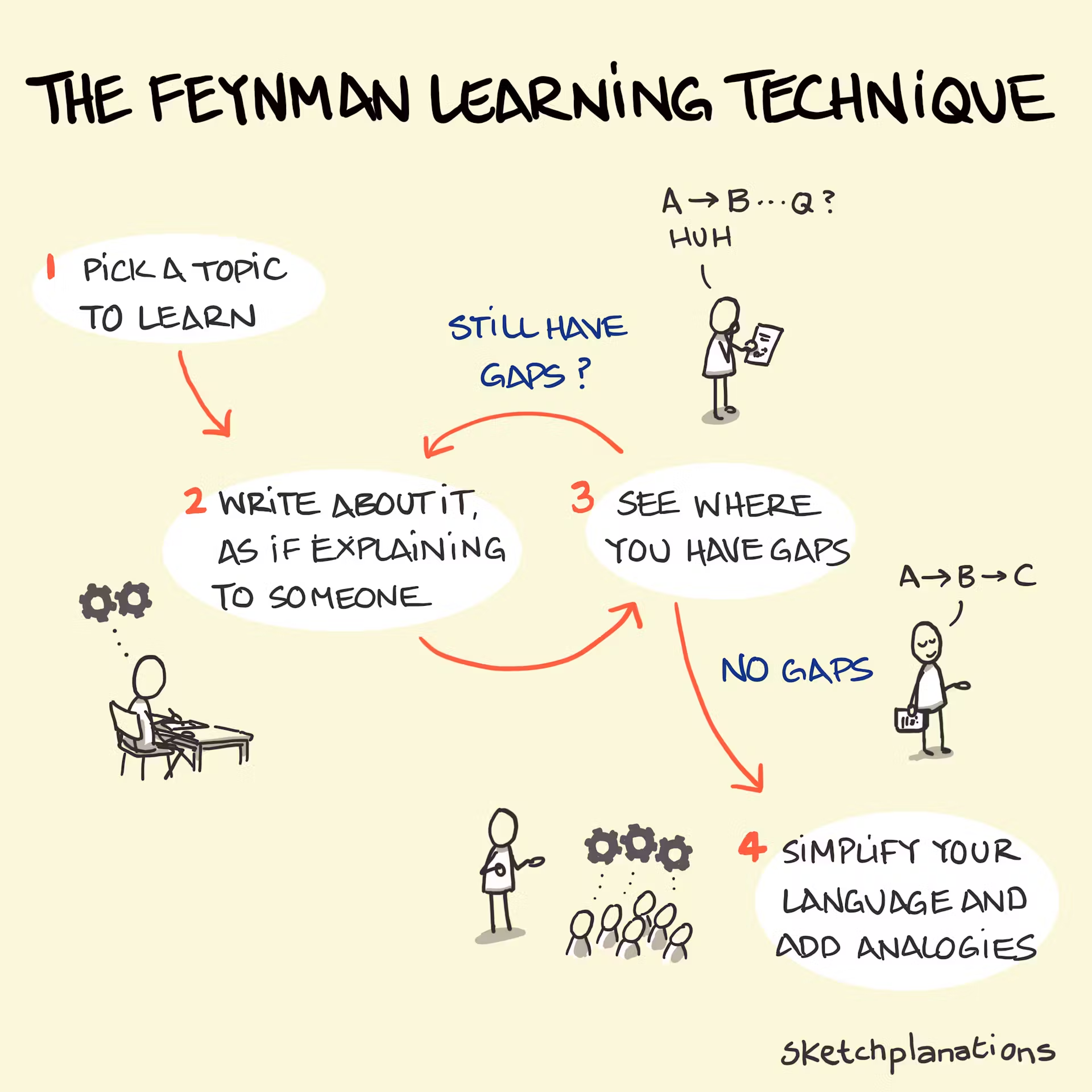
You'll have your child explain the topic they have their upcoming test on to you (steps 1 and 2).
In their explanation, you'll quickly know where their gaps are based on whatever information they forgot, got confused on, or what they couldn't explain simply (step 3).
If they were able to explain everything, make them do it again as if you were 5 years old (step 4) → The simpler they can break complex concepts down, the better grasp they have on that information. Keep in mind that you want to keep prompting them for clarity: keep asking them the whys, hows, what do you mean by that, explain it simpler, etc. You really want them to get to a point where they can explain the information simply, smoothly, and effortlessly!
Repeat this process, both making sure they can explain all of the necessary information and explain it simply.
You can scale the explanation part to as if you were 5, 15, 25, etc. The better they can explain something, at varying levels of complexity, the better they understand the information, and thus, the better they will do on their test.
This one is similar to the Summary Method with the major difference being, having them explain the information simply, like you are 5 years old. This one takes even less work from you, as you you don't need to have watched or read what they studied—its even better that you don't/didn't because then it really requires your child to give you all of the necessary information to understand whatever it is they are talking about.
3. Pomodoro Technique
This is part study technique and part attention technique and, after your initial explanation to your child, doesn't require much effort from you.
Simply put: this is a technique where a timer is set, typically for 25-30 minutes, and you do work for the 25-30 minutes, take a 5 minute break, and repeat.
The first step is to have your child seated in an area that has as little distractions as possible. The less things for them to look at, touch, play with, and lose focus on the better. Then you'll set an alarm for 25 minutes. The real key to this technique is not focusing on the fact that there is this big task that needs to get done. The only thing your child should be worrying about is the 25 minute timer and getting as much work as they can get done in that 25 minutes. When their mind focuses on the 25 minute timer and the fact that they have a deadline, so to speak, they are tricking their brain into being more productive and getting more done. Since the brain thinks there is only a finite amount of time, it will go into “overdrive” and try to get as much done as possible in that short amount of time.
I encourage you to explain that to your child so that they don't think they are just working on and off—there is a method to the madness! After the 25 minutes is up, your child should take a 5 minute break. Feel free to combine this with any of the other study techniques. So for example, they could practice the Feynman technique or summary method in that 25 minutes and their explanations to you, would be a part of the 25 minutes.
We did our best to pick study techniques that would be low-lifts for you because you probably and understandably have so many things going on and can't always commit the time to help your child study. If you try any of these out, please let us know how they went, and good luck with the beginning of the school year. Your child is going to do amazing this year!!